 |
| A photograph of a scoria rock A photograph of scoria, a description of the rock and a description of how it was formed. Scoria is a less technical term for macrovesicular volcanic rock and it is commonly basaltic or andestic in composition. Scoria is considered light but has a gravity more than one and sinks in water. Scoria differs in the textural tone than other volcanic rocks because they have larger vesicles and thicker vesicle walls and is often darker in colour (dark brown, black or red). Scoria is a rock full of bubble holes and the bubble holes were formed as the lava spewed out of the volcano and were trapped as the lava cooled and hardened. |

Thursday, August 26, 2010
Organ Pipes National Park: Part 6

Organ Pipes National Park: Part 5
 |
| Horizontal stones at Tessellated Pavement |
 |
| Vertical stones at Tessellated Pavement Include your photos. Explain how the tessellated pavement formed. Include a photo of the vertical columns as well of the rocks that make up the pavement. The Tessellated Pavement was formed very much the same way as the Organ Pipes was formed except that it was built on "top" rather than underneath the lava flow and everyting from the Organ Pipes. This was not shown yet as the rocks in the Tessellated Pavement is much newer than the rocks that make up the Organ Pipes. |
Thursday, August 19, 2010
Organ Pipes National Park: Part 3
 |
| Sedimentary rocks underlying the New Volcanics in Organ Pipes National Park |
What are these rocks doing here? Why are sedimentary rocks so close to igenous rocks? Which rocks are older?
The valley of Jacksons Creek exposes steeply dipping fossilised Silurian sedimentary rocks overlain by flows from the Newer Volcanics basalt. They differ from the rocks in the Organ Pipes because these rocks are igenous rocks formed from lava while the latter are sedimentary rocks. The sedimentary rocks are so close to the igenous rocks because they were initially one type of rock but erosion, weathering and other natural disasters caused the rock to seperate and forming sedimentary rock. The igenous rocks are much older than the sedimentary rocks because they were the original rock that were there in the first place because they were created from the old volcanic areas in the park.
Wednesday, August 18, 2010
Organ Pipes National Park: Part 2
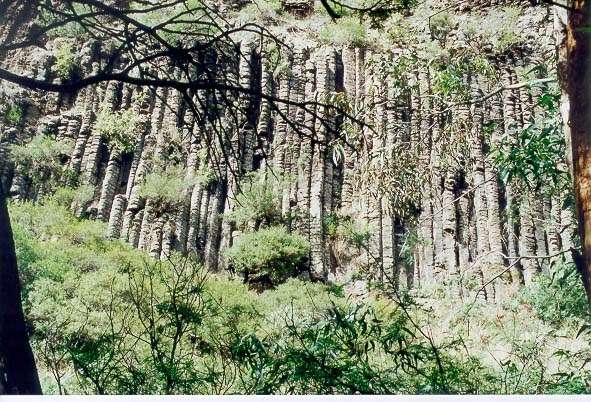 |
| Organ Pipes close up A photograph, and a written description of the Organ Pipes, an explanation of how they were formed, and an explanation about why they are considered so special a National Park had to be created. The Organ Pipes are a set of basalt columns that are as straight and regular as regular pipes and it is the central feature of the park. They were formed a million years ago when a large lava flow which was about 70 metres thick spread over the plains from nearby volcano hills. A surface crust was formed and the lava beneath slowly cooled down and began to join together. Vertical cracks on the surface began to develop and as the lava continued to get harder, the cracks got longer in length until the basaltic mass was divided into columns. Over the next million years, Jacksons Creek cut a deep valley through the basalt layer to expose the formation known as the "organ pipes". They were considered so special that a National Park had to be created because environmentalists wanted to preserve the remaining flora, fauna and the unusual basalt formations along Jacksons Creek because the area was beginning to be settled in. |
Organ Pipes National Park: Part 1
 |
The rise and the end of Jackson's Creek. |
 |
| Location of Organ Pipes National Park |
 |
| Valley at the Organ Pipes National Park |
A map of the area, showing Jackons Creek - where it rises, where it ends, and the location of the Organ Pipes.
A photograph, and a written description of the valley, and an explanation of how the valley was formed.
The valley is a vast dry wasteland and an important part of the Organ Pipes National Park. The Maribyrnong Valley Committee decided to focus on the valley in 1972 and restore it to what it was before the Europeans came. The biggest problem was the serious rate of soil erosion. The MVC checked local valleys for vegetation, collected seeds, bred seedlings in their backyard, conducted fifteen working bees annually and started planting trees on the fact that large plants with root systems to match would stop the erosion. A member of the MVC did a bird survey for fifteen years, checking that the return of indigenous species would come back as the flora recovered.
Subscribe to:
Posts (Atom)